
RUFADAA Law by State
Research verified against official statutory sources:
Estate documents answer important questions about authority, but online accounts introduce another layer. An executor, trustee, agent, guardian, or other fiduciary may have legal authority and still need to satisfy a digital custodian’s disclosure process before protected information is released.
Most states have enacted a version of the Revised Uniform Fiduciary Access to Digital Assets Act, commonly called RUFADAA, or another digital-fiduciary statute. These laws address when custodians may disclose digital assets, what documentation fiduciaries may need, how the content of electronic communications is treated, and how a user’s own online directions interact with wills, trusts, powers of attorney, and terms of service. The details are not identical in every state.
That variation is why this resource is organized state by state. It is intended to help consumers, attorneys, trustees, personal representatives, advisors, banks, trust companies, and other fiduciaries identify the controlling framework and then go directly to the official statute.
The central legal question: who has authority, and what may be disclosed?
Digital estate administration is not simply a password problem. A fiduciary may need to establish identity, death or incapacity, appointment or authority, the connection between the user and the account, and the scope of the information requested. The custodian may also have to determine whether the user consented to disclosure of private communications and whether federal law permits the requested disclosure.
RUFADAA-style statutes generally distinguish the content of electronic communications from other digital assets. That distinction matters. The body of an email or private message can receive different treatment from non-content account information, files, transaction records, or a catalog identifying correspondents and dates. The exact process depends on the state statute and the request.
Why online tools can matter more than people expect
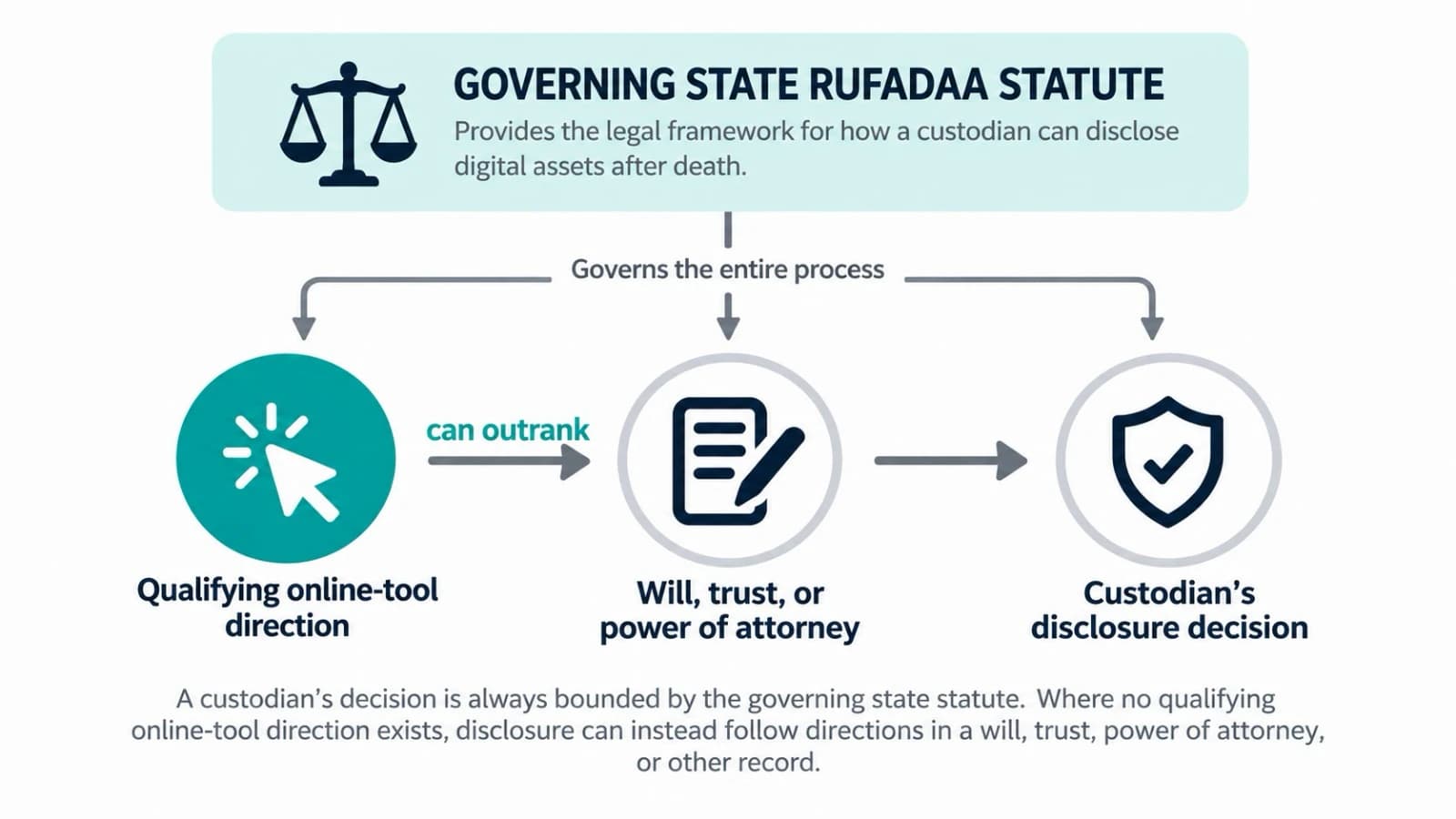
A recurring feature of RUFADAA-style laws is the statutory treatment of an online tool: a mechanism supplied by a custodian that allows a user to direct disclosure or nondisclosure of digital assets. In many of the states covered here, a qualifying direction made through such a tool can override a contrary direction in a will, trust, power of attorney, or other record.
That does not mean every account setting overrides every estate document. The controlling rule depends on the statute and whether the online mechanism satisfies its requirements. But it does mean digital estate planning cannot safely be reduced to ‘put it in the will.’ The account-level direction may be part of the legal hierarchy.
Flagship state guides
Florida
Florida Statutes ch. 740
Summary administration orders accepted; 60-day custodian deadline; will-deposit duty preserved
View guideCalifornia
California Probate Code Part 20 (§§870–884)
Agents and conservators added January 1, 2025; §13101 small-estate affidavits accepted
View guideTexas
Texas Estates Code ch. 2001
§205.001 small-estate affidavits accepted; medical powers of attorney excluded
View guideNew York
EPTL art. 13-A
Covers voluntary and temporary administrators; shaped by Surrogate’s Court decisions
View guideSouth Dakota
SDCL ch. 55-19
Trust-owned accounts disclose content to the trustee; conservators instead of guardians
View guideNevada
NRS ch. 722
Online-tool direction can control when statutory conditions are met
Virginia
Va. Code art. 3.1, §§64.2-116 et seq.
Online-tool direction can control when statutory conditions are met
Pennsylvania
20 Pa.C.S. ch. 39
Online-tool direction can control when statutory conditions are met
Illinois
755 ILCS 70
Online-tool direction can control when statutory conditions are met
Delaware
12 Del. C. ch. 50
Different statutory framework; do not present as standard RUFADAA
Core concepts that apply in every state
The state guides above focus on what is different in each statute. The ideas below work the same way across RUFADAA-style laws, so they are explained once here.
What counts as a digital asset
These statutes define a digital asset as an electronic record in which an individual has a right or interest, excluding the underlying asset or liability unless it is itself an electronic record. That covers stored files, cloud content, account information, and electronic records, not only cryptocurrency. A password is not a digital asset in this sense, and knowing it is not the same as the legal right to obtain disclosure: credentials authenticate a login, while fiduciary authority is a legal relationship.
Content versus catalogue
Every state guide splits a deceased user’s accounts into two requests. The content of electronic communications, meaning the substance of emails and private messages, generally requires the user’s consent or a court order, because the statutes were drafted around the federal Stored Communications Act (18 U.S.C. §2701 et seq.). The catalogue, which identifies the people the user communicated with and the time and date of each communication, together with other non-content digital assets, is generally available to a properly appointed personal representative unless the user prohibited it. Asking for the narrowest category that meets the need makes a request easier to grant.
What a custodian may hand over
When it discloses, a custodian may choose to grant full access, partial access sufficient for the fiduciary’s task, or a copy of the assets the user could have accessed. It may charge a reasonable administrative fee, need not disclose assets the user deleted, and may decline a partial request that would impose an undue burden, in which case a court can order a date-limited subset, everything, nothing, or in-camera review. The goal is to give the fiduciary what the role requires, not to recreate the user’s whole digital identity.
What these laws do not do
- They do not require providers to hand over passwords or decrypt devices.
- They do not give a fiduciary more rights than the user had.
- They do not displace federal privacy law, copyright law, or applicable terms of service where the user gave no direction.
- They do not allow a fiduciary to impersonate the user.
- They do not apply to an employer's digital assets used by an employee in the ordinary course of business.
What this means for planning
A practical digital estate plan lists the accounts that would matter, checks whether each provider offers a legacy or disclosure tool, and makes sure those settings agree with the will, trust, and power of attorney. It should also state consent to disclosure of message content if the user wants it released, and identify who will need access and what they will need to prove. Business owners need a separate continuity plan, because company systems used by employees fall outside these personal statutes.
Common questions this resource answers
No. A will can be part of the authority analysis, but disclosure can also depend on the state digital-asset statute, federal law, the user's directions, the custodian's process, and the category of information requested.
No. These statutes establish rights and procedures concerning access and disclosure. They do not simply require a custodian to hand over every password.
In many RUFADAA-style states, a qualifying online-tool direction can take priority over a conflicting direction in a will, trust, power of attorney, or other record. Check the state-specific page and statute.
The content of electronic communications is subject to heightened privacy rules. State statutes often require user consent or a court order plus specified documentation before content is disclosed.
No. Delaware uses its own Fiduciary Access to Digital Assets and Digital Accounts Act and should be analyzed on its own statutory terms.
How to use these guides
Start with the state in which the user resides or resided at death and confirm the statute’s applicability rules. Then identify the fiduciary role, the type of digital information needed, any online direction the user made, and the documentation the custodian may require. Use the linked official statute as the controlling source.
These guides are educational. They are designed to make the statutory structure understandable and searchable, not to replace legal advice about a particular estate, trust, power of attorney, guardianship, account, or disclosure request.
Educational information only. Not legal advice. Laws, provider procedures, federal requirements, and individual circumstances can change the result in a specific matter. Consult qualified counsel for legal advice.