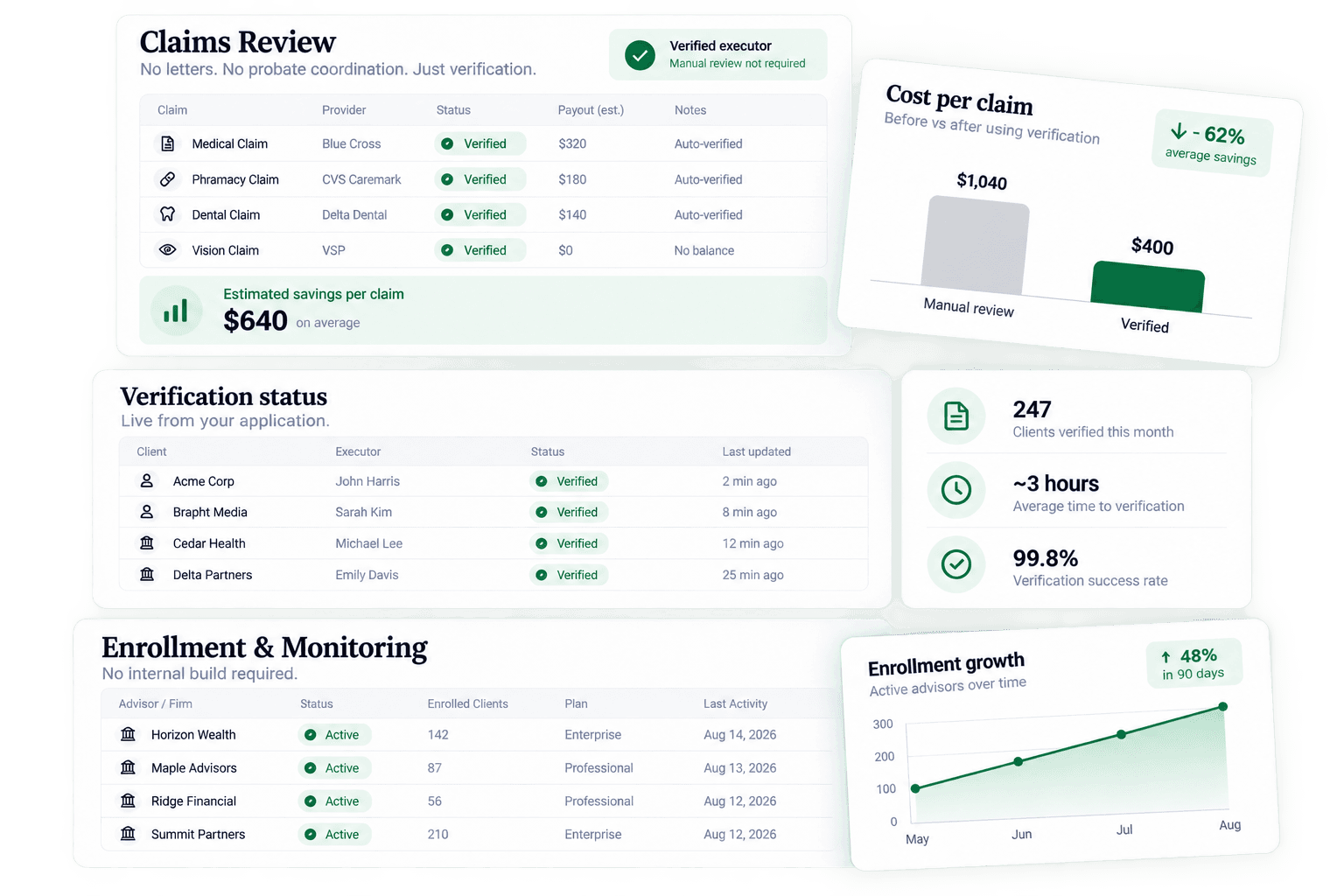

Every estate claim starts as a manual review. Yours does not have to.

When a client passes, the executor reaches your team already verified, with a release that is logged, dated, and defensible. Letters Testamentary review and probate coordination, two of the most resource-intensive steps, are handled before the file reaches you. It fits within your existing fiduciary process, while helping the family stay with the institution that made one of their hardest weeks easier.

Built to reduce the manual review behind every estate claim.

A compliance officer reviewing estate claim documents

The claims process your team already runs, verified before it reaches you

An estate event is also where assets tend to leave an institution. Handle it well and they stay. Vesperly makes the estate transition the moment you keep the relationship, not the moment you lose it.

No Letters Testamentary review. No probate coordination.

Identity verification confirms the executor, so manual review is no longer required.

  • Identity verification confirms the executor, so manual review is no longer required
  • Estimated savings of $640 per claim
  • Lawful under RUFADAA Tier 1
See the model
No Letters Testamentary review. No probate coordination.

An SDK, not a rebuild.

One integration, and every enrolled client's executor arrives pre-verified.

  • One integration, and every enrolled client's executor arrives pre-verified
  • Three-layer pricing: platform license, per-advisor royalty, per-end-user royalty
  • A full audit trail at every step
  • Defensible for compliance review
Explore SDK integration
An SDK, not a rebuild.

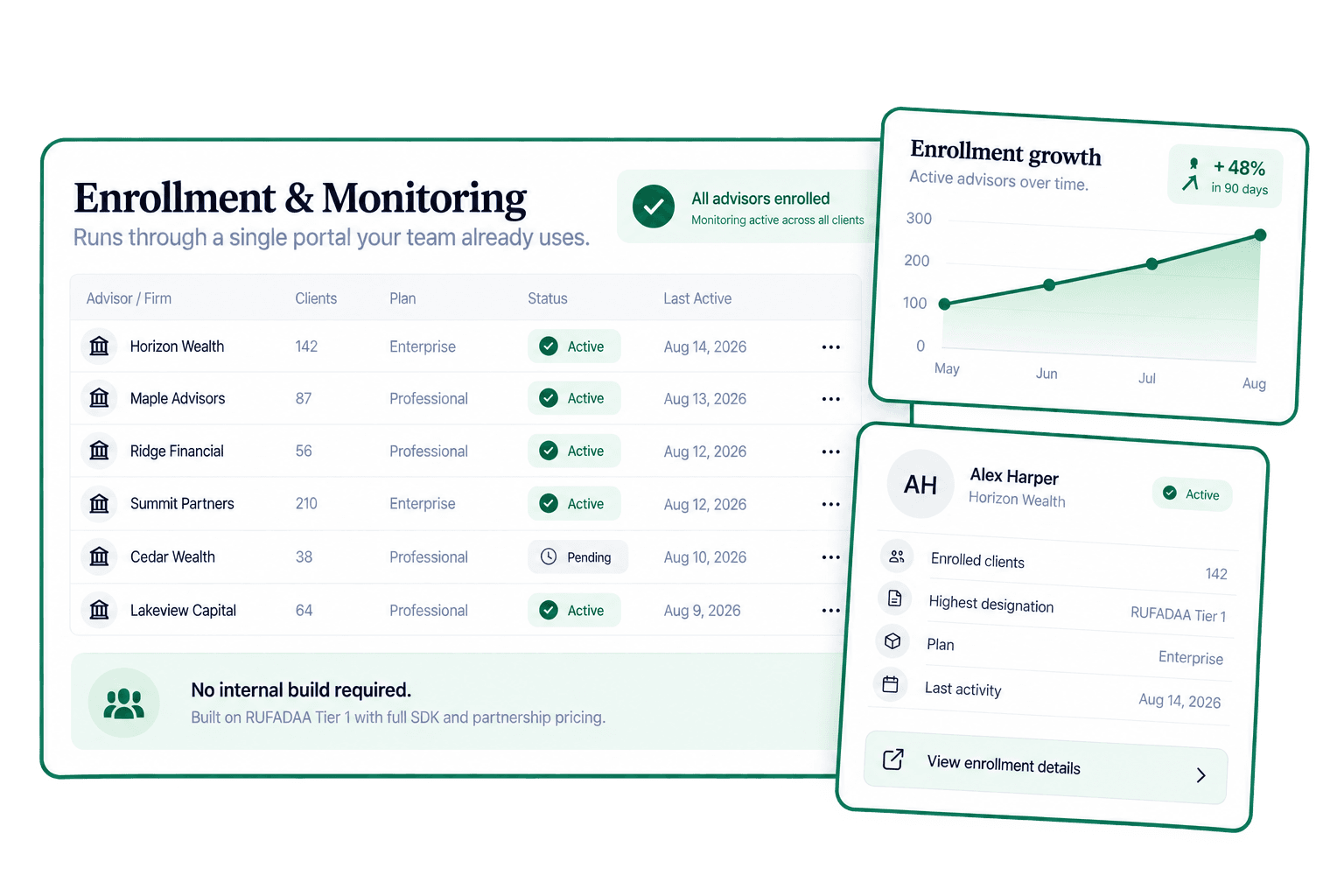
No internal build required.

Enrollment and monitoring runs through a single portal your team already uses.

  • Built on the RUFADAA Tier 1 online tool designation
  • Full SDK and partnership pricing shared in a conversation
  • The highest designation available under RUFADAA, for the records it holds
Explore institutional partnerships
No internal build required.

Beyond the claim desk

The cost shows up in more than one department.

Commercial credit

When a business borrower dies, access problems can quickly become credit problems. Payroll, merchant processing, banking, and other critical systems may be left without someone who can reach them while the estate is settled. A named successor with verified access helps keep the business operating and protects the underlying collateral.

Fiduciary defensibility

12 CFR 9.6 requires a bank to review a prospective fiduciary account before accepting it and determine whether it can properly administer that account. Examiners test documented judgment. A password list handed over by a family member is not a documented process. Vesperly provides verified access with a dated audit trail your team can review.

Dormant accounts

Accounts an executor does not know exist can eventually become dormant and subject to unclaimed property processes. Giving the verified executor an organized inventory helps them identify and address those accounts as part of the estate.

A team reviewing compliance documents together

RUFADAA gives a Tier 1 online tool designation legal priority over a Will, for the records it holds, in 47 states and Washington DC. Every estate case currently arrives as a queue of unverified claims. With Vesperly, they arrive resolved.

Your Will says who. Vesperly says how.

A claims process your team does not have to run by hand.

Your questions, answered

Community banks, regional institutions, credit unions, and trust departments that process estate claims and want to cut both cost and processing time.

A single SDK integration. Once it is live, every enrolled client's executor arrives at your desk pre-verified, with a full audit trail attached.

Estimated at 80 percent per claim, or roughly $640 in avoided cost.

Yes. RUFADAA Tier 1 gives this designation legal priority over a Will, for the records it holds, in 47 states and Washington, D.C.

No. Vesperly verifies the executor and releases records to them directly. Vesperly itself never logs into a customer account.

The institution typically needs to confirm the death and establish who has the legal authority to act before releasing information or assets. Vesperly helps streamline that process by verifying the named executor and providing a logged, dated release with an audit trail, reducing the manual review involved in handling deceased accounts.

No, it strengthens it. Every verification step produces a timestamped audit trail, ready for your compliance team to review.

Three layers: a platform license, a per-advisor royalty, and a per-end-user royalty. Full details are shared in a partnership conversation.

SOC 2 Type II is currently in progress. Documentation is available for institutional compliance review on request.

Death of a guarantor can trigger a nonmonetary default that may not be curable. A named successor with verified access keeps the business operating and the collateral intact while the estate is settled.

Every release is verified and supported by a dated audit trail, giving your team a documented record of who was verified, what process was completed, and when access was released. That gives fiduciary and compliance teams a clearer record to review than an informal handover of passwords or account information.